
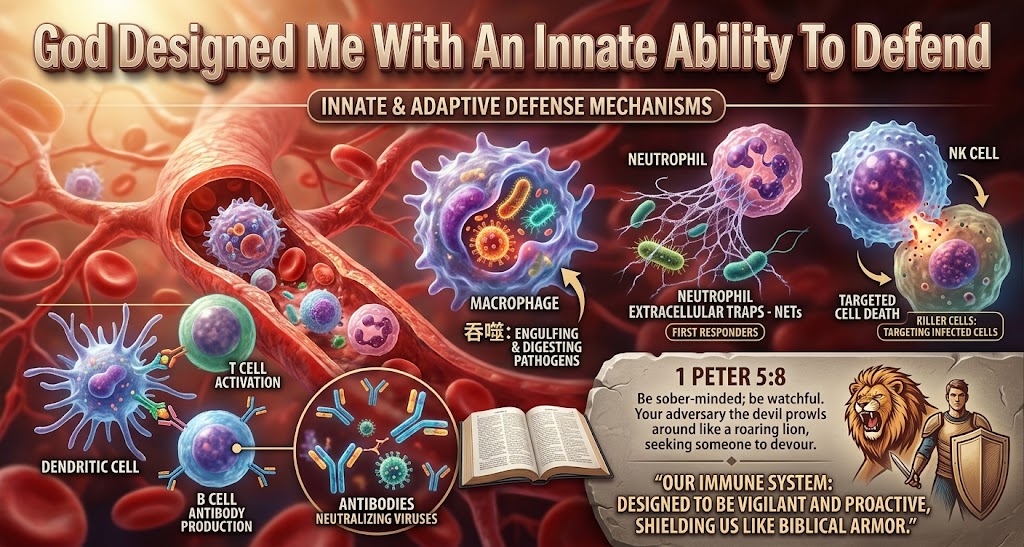

As you read in the last article of our series, we have a vast number of cells that God used to build our human bodies. Now, let’s take a closer look at how our cells fight incoming foreign invaders so we can keep on fulfilling His purposes in our lives.
Our blood is the medium pumped throughout our vessels carrying oxygen, carbon dioxide, nutrients, platelets, erythrocytes, and five types of white blood cells (WBCs) we refer to as leukocytes. Each of our leukocytes were produced by red bone marrow housed in our bones, but they are structurally different, meaning they all function in different capacities. In fact, all begin as immature cells (blast cells), and depending on what factors are present, they will differentiate into their mature form. Some even travel to different locations in the body, like our T cells, to go through another stage of maturation to “train them” on their role.
There are two main categories of leukocytes: granulocytes and agranulocytes. Granulocytes have little granules surrounding their nucleus that function to lead to the breakdown of foreign cells that sneak past our mechanical barriers (Ex. skin and mucus). There are three categories of granulocytes: neutrophils, basophils, and eosinophils. Agranulocytes lack granules. The two agranulocytes are monocytes and lymphocytes. Most individuals have heard of lymphocytes because they have heard how HIV impacts the T cells and B cells. As goes with the name, the lymphocytes travel in the lymph and are a key player in the lymphatic system.
As stated before, the five leukocytes are different, but they work together for a common purpose. Isn’t it interesting how God patterns his creation? Like members of Christ’s church who all have a role in the body, each one of our little members inside of us have a purpose, and although different, they are indispensable (1 Cor 12:12–24). Neutrophils are your most common type of leukocyte. They target bacterial and viral invaders. So, if you think back to the last time you had blood work if there was an elevated count of neutrophils, that indicated you likely had a bacterial or viral infection. Eosinophils are named due to their red color. When the red dye, eosin, is used to stain them, our eosinophils glow red under the microscope. They work to help your body fight allergens by inducing inflammation, itching, and redness. Additionally, they’re the best leukocyte for fighting protozoa and parasitic worms. The toxic substances released by their granules are able to eradicate these foreign invaders.
Basophils, along with the eosinophils, are the least common WBCs in the body. Basophils are named because they present a blue hue when died with a basic dye. Again, like eosinophils, they also aid in allergic reactions by producing histamine, which provokes swelling and inflammation. Most of the time, we constantly try to reduce inflammation with medications like anti-inflammatory drugs, but in many cases, a certain amount of inflammation is actually vital to keeping a problem localized and allowing the body to bring factors into that area to help it heal! Basophils also release heparin, which is an anticoagulant. This becomes of utmost importance when a blood vessel breaks, or we need to produce a scab when we have a cut.
The second most common leukocyte is actually an agranulocyte: the monocyte. It is a very special cell that is able to migrate by squeezing through our blood vessels to get to damaged tissues that have signaled they are in distress. When the monocytes migrate, we call them macrophages. “Phage” literally means to eat, so the macrophages “nom nom nom” foreign invaders. After the invader is engulfed, special enzymes within the newly formed complex are able to kill whatever is causing havoc. Last, but absolutely not least, we have the three categories of lymphocytes: Natural Killer Cells, T cells, and B cells. Natural killer cells are part of our non-specific defense mechanism because they don’t care what type of invader we have encountered. They will attack it with all their might! T and B cells differ in that they must be formally trained. After being formed in the red bone marrow, T cells will travel to the thymus to mature/be properly trained by “thymosins.” From that point, they will create memory T cells, cytotoxic T cells, and cells that are able to activate our B cells. These matured cells will show up in our blood and other organs that play a role in our immune system. B cells are formed and then subsequently mature in the bone marrow. Once matured, they can become plasma cells or memory B cells. Memory cells, in general, “remember” the patterns on the membranes of foreign invaders they encounter to make it easier to fight the same bacteria or virus if our body encounters it again. Plasma cells are those that produce our antibodies (immunoglobulins) and are most commonly activated by T cells. Antibodies are a type of protein, and depending on their structure, they can last from days to years. That is one reason why it is unlikely for you to become ill from the same strain of virus for a long time after you encounter it the first time.
The good thing is, even if your antibodies specific for a particular virus break down, your memory cells can be activated to lead to the formation of new antibodies, so hopefully, you won’t get ill again.
Is it not amazing to think that God equipped our bodies with the ability to maintain internal stability (homeostasis) even when we are constantly being attacked by foreign invaders? These leukocytes, or WBCs, are constantly roaming in our blood and on surveillance in other organs, watching out for foreign invaders. This is a pattern that makes me think of 1 Peter 5:8. We as individuals have to constantly be on guard for all kinds of enemies that attack our spiritual bodies. May our body’s immune system and spiritual immune system always be sober and vigilant, watching out for foreign invaders, and be prepared to eradicate anything that could cause harm physically, emotionally, mentally, or spiritually.
If you thought this article was interesting, please look for the next article, where we discuss another type of barrier that we have: the skin and integumentary system and its role as a mechanical barrier!